01Research question
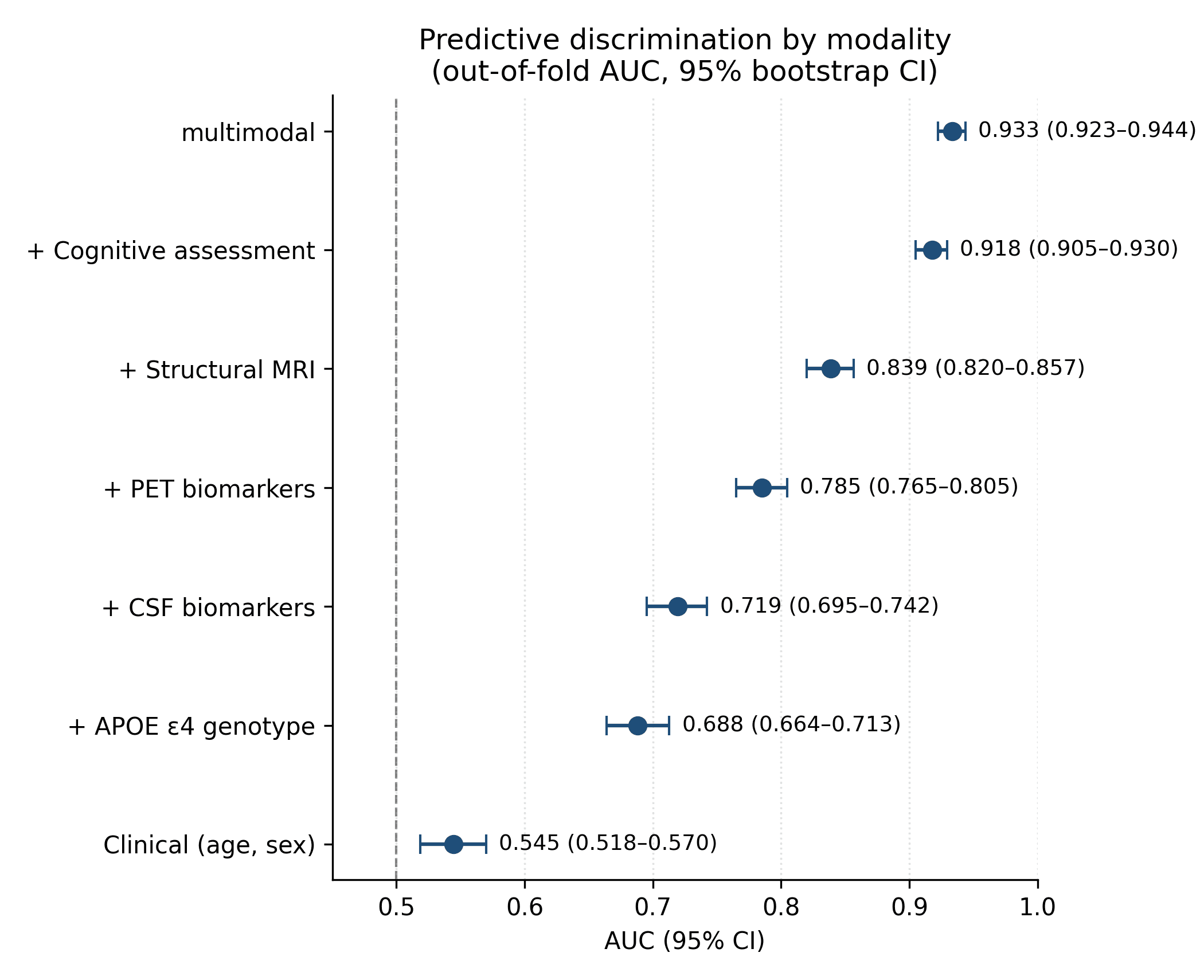
How much information is actually needed?
We compared clinical, cognitive, imaging, genetic, and fluid biomarkers to identify where the predictive signal actually comes from.
Trial Enrichment Agent · Independently Validated Models
Clinovia’s Trial Enrichment Agent uses clinical, cognitive, and biomarker-risk models to prioritize candidates before costly confirmatory testing and downstream trial procedures.
For Research Use Only. Not a diagnostic device.
The CRO Problem
Patient burden
Site burden
Lost recruitment time
Unnecessary cost
What if risk stratification happened upstream?
Clinovia Trial Enrichment Agent
Give the agent your protocol and candidate cohort. It applies the validated models that match your available data, ranks candidates by likely biomarker and progression status, and hands off a prioritized shortlist — before you spend on confirmatory testing.
Connects to your existing workflow — CSV, API, CTMS, or EDC.
Example Workflow
The agent applies your eligibility criteria, scores every remaining candidate, and shows exactly how tightening the threshold concentrates your highest-likelihood candidates into a smaller group.
Executive Summary
Clinovia Score · A+T+ Probability
0.18
Min
0.49
Median
0.48
Mean
0.71
Max
Enrichment by Threshold
Sample output from a synthetic demo cohort. For Research Use Only.
Example Application · Alzheimer's Disease
In Alzheimer's disease trials, Clinovia can estimate progression risk and biomarker status from baseline clinical and cognitive data before expensive imaging or CSF confirmation.
24-Month Progression
Age · Sex · MMSE · RAVLT · LDELTOTAL
Predicted Progression Risk
Validation
A simpler model with Age · Sex · MMSE externally validated on independent NACC and OASIS-3 cohorts.
A+T+ Biomarker Enrichment
Age · Sex · MMSE · RAVLT · LDELTOTAL
Estimated AT(N) Status
Validation
Developed and internally validated on ADNI. External validation is underway.
These are independent enrichment signals. The agent does not combine them into a single clinical score; trial teams can use the signals according to their protocol and confirm eligibility with the appropriate biomarker or clinical assessments.
Illustrative example. For Research Use Only. Not a diagnostic device.
Data-Driven ML Research · Alzheimer's Disease Case
We use Alzheimer's disease as a research case for a broader question: how can data-driven models improve trial enrichment without adding unnecessary screening burden?
We compared clinical, cognitive, imaging, genetic, and fluid biomarkers to identify where the predictive signal actually comes from.
The progression model was frozen in ADNI and applied unchanged to independent NACC and OASIS-3 cohorts.

The A+T+ classifier shows how a predictive model can become an explicit screening operating point for trial enrichment.
| Target | Sens. | Spec. |
|---|---|---|
90% threshold 0.322 | 90.3% | 32.5% |
95% threshold 0.268 | 95.4% | 24.3% |
98% threshold 0.145 | 98.3% | 10.2% |
Alzheimer's disease is Clinovia's current application case. The underlying approach is designed for data-driven candidate enrichment across clinical trial programs.
Trial Enrichment Agent