Back to research

Data-Driven ML Research · Alzheimer's Disease Case

How much information does trial enrichment actually need?

We investigated how much predictive information can be obtained from routine clinical and cognitive assessment, and what is gained by adding increasingly expensive or invasive modalities.

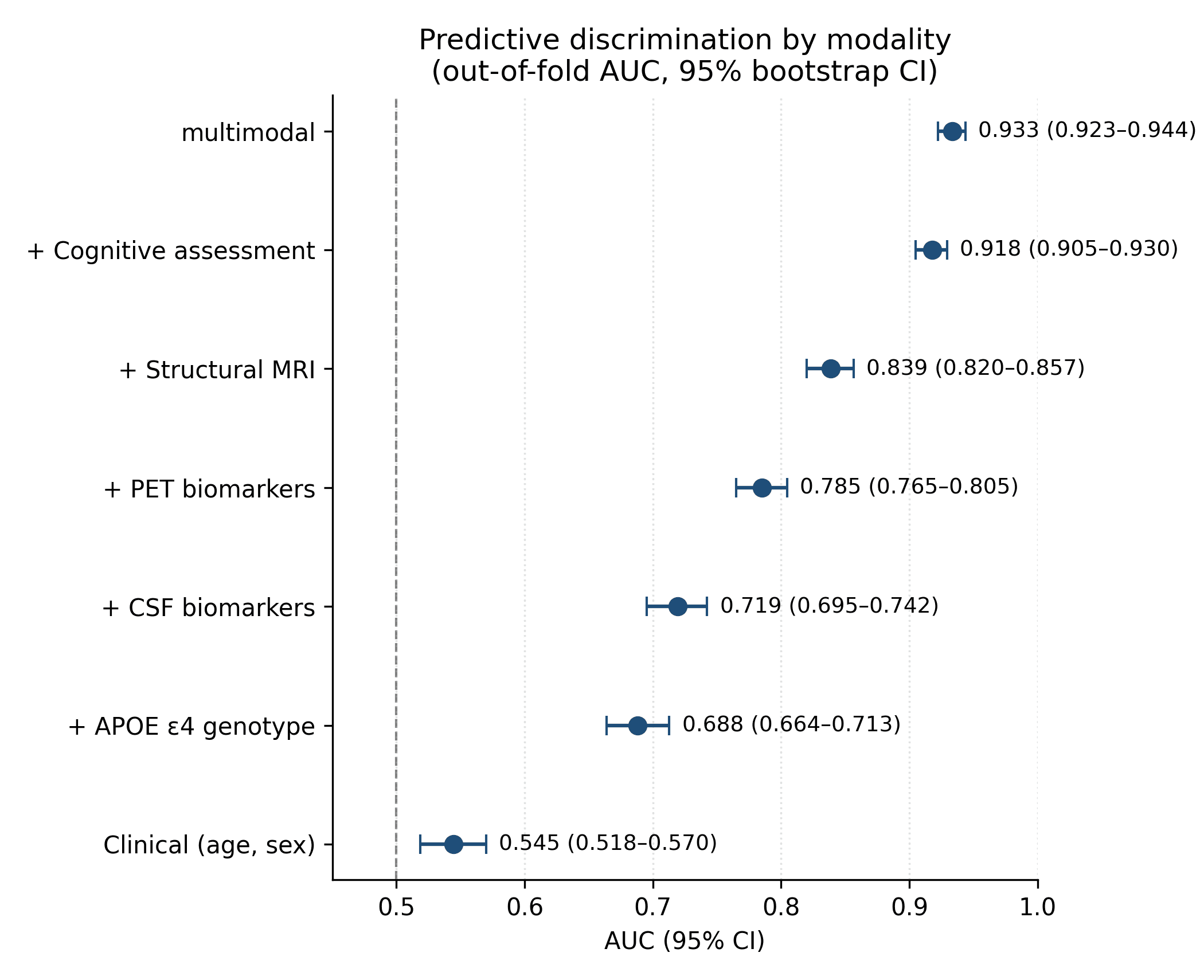
Forest plot comparing out-of-fold AUC across clinical, genetic, fluid biomarker, imaging, cognitive, and multimodal models.

Out-of-fold AUC comparison across progressively richer input modalities. Cognitive assessment provides a substantial increase in predictive performance, while the full multimodal model adds comparatively less incremental discrimination.

What we learned

More data is not automatically more useful

The research asks a practical question for clinical trial enrichment: which information is worth collecting before confirmatory testing?

Clinical variables

Baseline

Age and sex provide a starting point for progression-risk prediction.

Cognitive assessment

Major signal

Adding cognitive measures substantially increases predictive information.

Additional modalities

Incremental

Imaging, genetics, and fluid biomarkers add information, but with substantially greater acquisition burden.

Underlying research

Preprints and methodology

Four studies examine the question from complementary perspectives, from individual cognitive assessments to systematic multimodal comparison.

medRxiv 2026.360561

Comparative Value of Cognitive and Functional Assessments for Predicting 24-Month Progression from Mild Cognitive Impairment to Alzheimer's Disease: An ADNI Cohort Study

Which cognitive and functional assessments contribute the most predictive information for 24-month progression?

View Preprint

medRxiv 2026.360413

Systematic Modality Ablation of Multimodal Machine Learning for Predicting 24-Month Progression from Mild Cognitive Impairment to Alzheimer's Disease

How much does each additional modality contribute when clinical, cognitive, imaging, genetic, and fluid biomarkers are evaluated systematically?

View Preprint

medRxiv 2026.359630

Standardized Comparison of Clinical, Cognitive, Genetic, Neuroimaging, and Fluid Biomarkers for Predicting 24-Month Progression from Mild Cognitive Impairment to Alzheimer's Disease

A standardized comparison of major biomarker modalities under a common modeling framework.

View Preprint

medRxiv 2026.356189

Predicting 24-Month MCI-to-Alzheimer's Conversion Using Routine Clinical Assessments Without Neuroimaging or Genetic Testing

Can routine clinical and cognitive assessments provide useful progression-risk stratification without requiring imaging or genetic testing?

View Preprint

Alzheimer's disease is Clinovia's current application case. The underlying research program asks a broader question: how can data-driven models identify useful enrichment signals before costly confirmatory testing?

Back to research